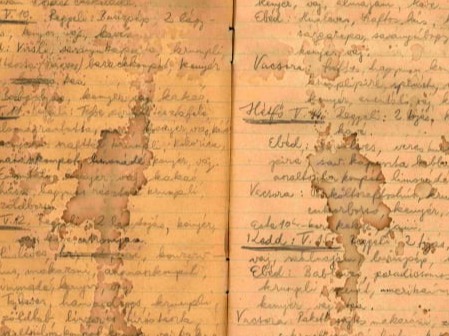
Diary excerpt
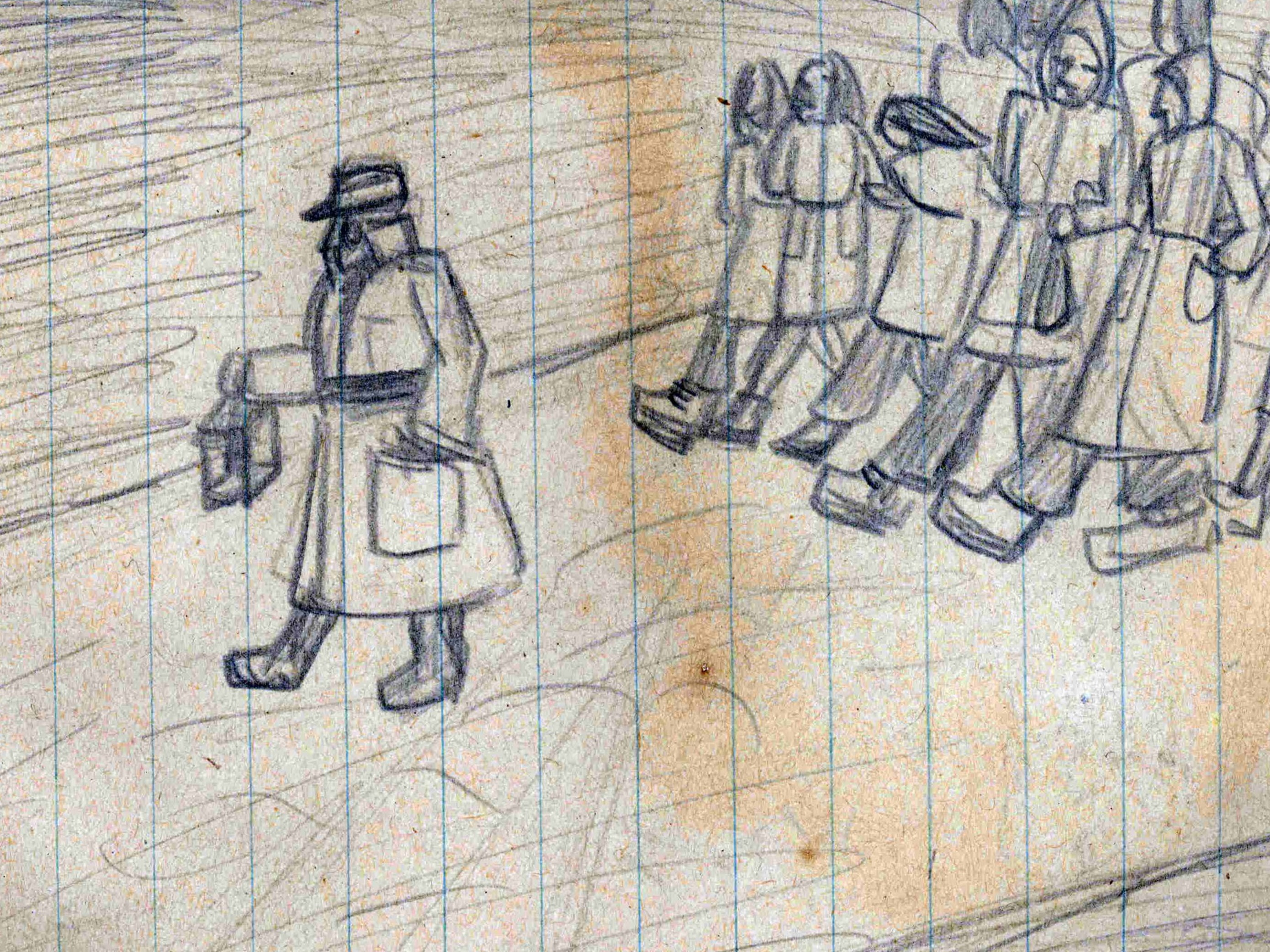
Drawing: “Night shift”
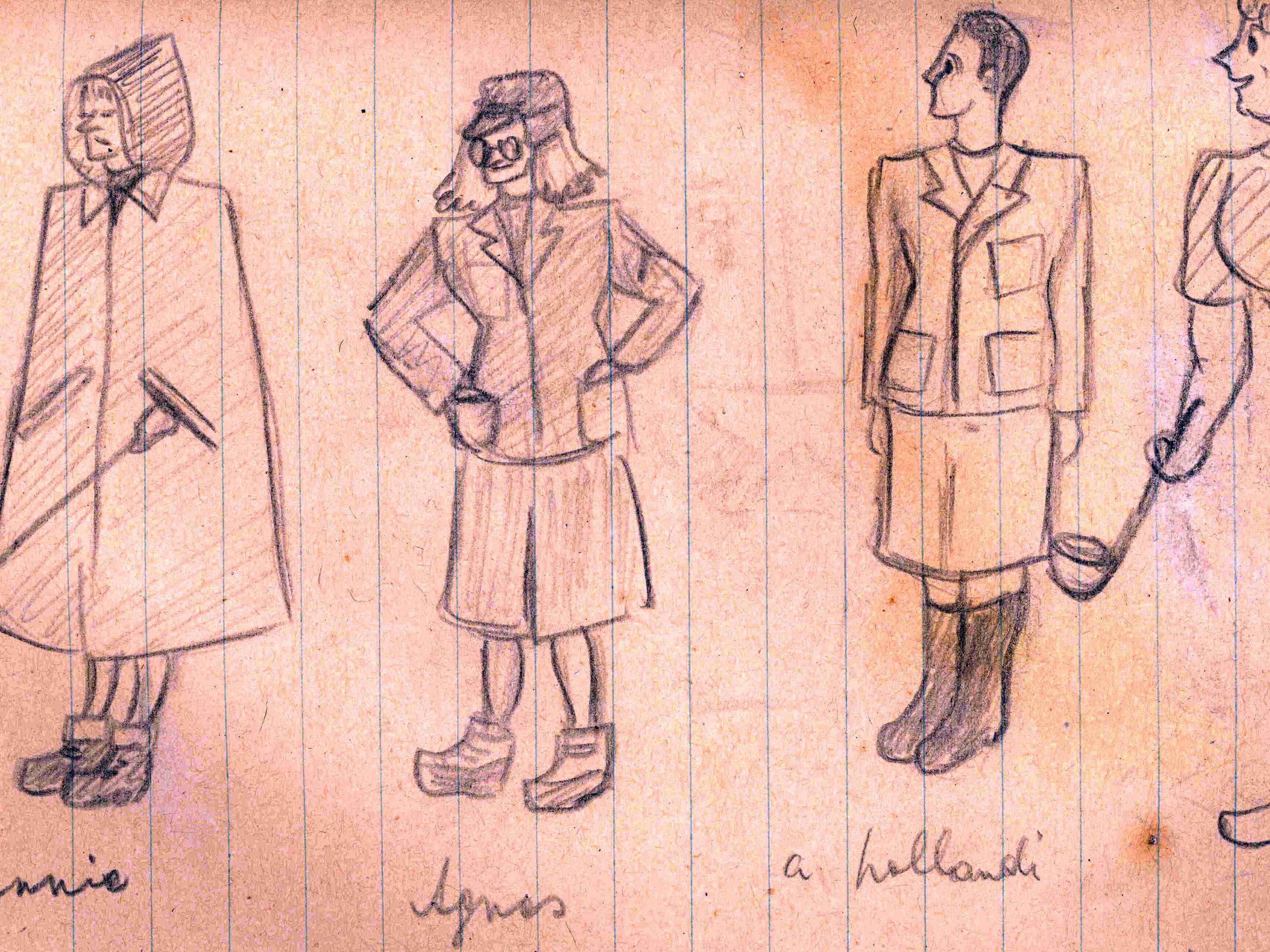
Depiction of SS female guards
Rózsa Deutsch was among the approximately 70 women who were so weakened that, during the evacuation of the subcamp, they were left behind in the camp. On 13 April 1945 the women were discovered by US soldiers, given emergency medical care, and on 17 April 1945 transferred to a military hospital at Altenburg-Nobitz airfield, and later taken to Waldenburg. After liberation, Rózsa Deutsch began writing a diary in which she recorded her journey back to Budapest via Altenburg, Waldenburg, Zwickau and Karlsbad. In 2001, Rózsa Deutsch donated her diary to the Buchenwald Memorial.
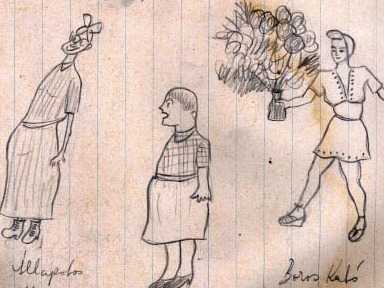
In this diary she describes her experiences in newly regained freedom. The diary is characterised by numerous sketches and drawings which, on the one hand, reflect her experiences in the subcamp and, on the other, depict the lives of the liberated women in Altenburg and Waldenburg. She often portrays her fellow prisoners in a caricatured manner. In addition, there are finely executed views of the hospital in Altenburg and of the town of Waldenburg.
Below you can see a few short excerpts from the original diary and a partial transcript.
Reproduction - Source: Archiv Gedenkstätte Buchenwald – BwA-K-32-XIV-1 -Tagebuch der Rosa Deutsch
Altenburg
From 7 May 1945 to 20 May 1945, the diary contains only entries recording what she was given to eat. For example:
Monday, May 7
Breakfast: semolina porridge, bread, butter, apricot jam, bacon omelette, oranges, and coffee
Lunch: rice soup, chicken, mashed potatoes, pear compote, tea, bread, and butter
Supper: fish cakes, potatoes, tomatoes, carrots, cocoa, bread, and butter
Sunday, May 13
Breakfast: omelette, egg-baked bread, butter, apple purée, and coffee
Lunch: chicken broth, meat with gravy, potatoes, carrots, redcurrant compote, bread, and butter
Supper: tinned meat with gravy and onions, mashed potatoes, spinach, sour cherry compote, bread, Emmental cheese, butter, and cocoa
A loose insert dated 31 May 1945, entitled “Vidám estünk műsora” (“Programme for our merry evening”), describes the programme for an entertainment evening organised by the former forced labourers themselves. There is also a list of the names of twenty former fellow prisoners.
The programme
1. The march-in of the American soldiers (one, two, three, four)
2. Spanish grandee and his wife (Boros, Deutsch)
3. [illegible] Diseuse (Raskai Ágnes)
4. Spanish dancer and Toreador (Boros, Deutsch)
5. Bullfight (Frisch, Deutsch)
6. Edit, the guard/overseer (Raskai Ágnes)
7. Imitation
8. Greek shepherd boy (Raskai Ágnes)
9. School (Boros, Frisch, Raskai, Huba, Deutsch)
10. Parade/march-past (one, two, three, four)
Waldenburg
Between 8 June 1945 and 11 June 1945, the women were transferred to Waldenburg. Among other things, two drawings were made: “View from a room in our house” and “View from the attic room.”
Zwickau
On 27 June 1945, they moved on to Zwickau. From this point onwards, the descriptions of events become more detailed.
June 27
Journey from Waldenburg to Zwickau in an open vehicle in pouring rain. Accommodation in the camp.
June 28
Performance by the Italians in the camp.
June 29
Sleeping places on the floor, in the dirt, hunger.
June 30
In the morning, the Americans wanted to take us with them to Jena. By majority decision, we refused to leave. The situation is hopeless. There is nothing left to eat. At midday we were given some peas, but supposedly for the last time. Our position is utterly hopeless. The Americans are leaving the town. The commander said he would not force us to travel, but he will not provide us with provisions or vehicles in the direction of Pilsen. Despair is great; many say they will set off on foot and drag their belongings behind them on handcarts. In the evening, word reached us that the Russians are supposedly going to march in tomorrow.
July 1
At last, the Russians arrived today. We have been waiting for them since 2 November 1944. In the morning an officer came to us in the camp, and at midday another one. In the afternoon we went into town. The town is very beautiful - especially lively today. The street is full of Serbs. Vera was a great success with them. Red flags can be seen everywhere with the slogans: “We greet the Red Army”, “We greet the heroes of the Red Army”, “Long live Comrade Stalin!” - the same also written in Russian. In front of the town hall there was a large crowd, and on the town hall three large Soviet stars.
A captured German officer is hoisting red flags in every window. We saw several churches, though we went inside only one; there was a red flag on its tower as well. There are many lovely shops - only with no goods. The villa quarter is enormous and the gardens are beautiful. I can also mention that from one garden we were given three onions - free of charge.
July 2
We slept terribly badly during the night. The room we slept in was full of biting bugs. Our situation is clearly improving; the rations have been better since yesterday as well. Breakfast: a small tin of meat, a slice of bread with dripping; coffee. Lunch: edible peas. Supper: a quarter of a loaf and a tin of meat. The Russians promise all good things. In the morning, they said we could move into the town today, but it has been postponed - they now say tomorrow. In the afternoon we went for a walk in town. Every quarter of an hour there’s a rain shower. We kept running into Serbs; we spoke at length with one of them. We saw Russians in cars, with wagons, and on horseback. In the evening, we went to the service at the Protestant church. By the end the sermon began to get boring, so we slipped away.
July 3
It’s been raining continually. Still nothing has come of the move. Every minute the news changes; no one knows anything for certain yet. Yesterday a Jewish boy arrived from Karlsbad who would transport us to Karlsbad in smaller groups. The people from Pécs, after doing a good bit of shopping, announced that they were taking their leave, along with their ladies. Tinned food was handed out: half of a large tin plus a small tin of meat was the ration. That was all, so we ate it with onions.
I sold 30 German cigarettes for 30 marks, and with this little fortune we went into town in the afternoon. It had been raining all the while, but we were doing well. We bought six postcards for 90 pfennigs, had seven beers and two coffees in a confectioner’s for 2.90 marks, and purchased three music exercise books (booklets with staves and clefs) for 8.50 marks. Then we went to the municipal library and registered. Between the two of us we borrowed four art books and paid 50 pfennigs.
July 4
We were in town both in the morning and in the afternoon. Somewhere we drank some meat broth - about 1 dl - for 20 pfennigs. We also went to the railway station. The station is very beautiful (and the traffic was heavy), and it was very busy too; many prisoners and emigrants are travelling now. In the waiting room we drank good beer for 25 pfennigs.
July 5
As far as our (homeward) journey is concerned, the situation is still unchanged. Strangely enough, it didn’t rain today. The women have been buying cellophane coats in droves - some even buy several. The largest size costs 25 marks. I heard that Braun, Tibor and his father bought twenty of them; they’re taking them home to do business with.
In the morning, we sold 20 American cigarettes for 40 marks, and with that we went into town in the afternoon. There is really a lot going on in town now. In the streets there are Communist posters; the Anti-Fascist Youth has been founded; they are distributing leaflets insulting the Nazis. One slogan reads: “Long live Soviet Germany!”
We went into three huge department stores. One had clothes of fairly good quality. In another, in the food section, you could buy flour, sugar, coffee powder, honey, sheep’s cheese, sauerkraut, butter, onions, carrots and cucumbers - of course all on ration cards. We bought a small linen bag for 1 mark, shoe insoles for 15 pfennigs, washing-up powder for 12 pfennigs, and playing cards for 15 pfennigs. Prices are very low: 1 kg of sugar costs 76 pfennigs, and 1 kg of bread only 30 pfennigs. In a chemist’s we also got lipstick for 3 marks, sanitary pads for 50 pfennigs, face powder, hand soap, and tooth powder for cleaning our teeth. At the pharmacy: borated Vaseline and Acetylin for 75 pfennigs; and in the stationery shop then exercise books and postcards. After that we got on the tram towards the station for 20 pfennigs, but on the way, we had to get off because a Russian car was standing on the tracks.
We went into a small pub where we were received very unfriendlily and were given only a cup of meat broth. After that we played cards and drank beer at the station until evening. We then came home drunk. [The last sentence is written in a different hand.]
July 6
Supposedly the first group is to leave for Karlsbad as early as tomorrow morning. As it would be a private venture, everyone had to contribute cigarettes or dress fabric. Today we bought 1.5 kg of bread from the Serbs for 20 American cigarettes. They fetched seven or eight loaves - still warm. They negotiate with the baker. In the morning, I bought myself a jumper from a German Communist for 20 German cigarettes.
Afternoon walk. We bought a brush for 65 pfennigs, lipstick for 3 marks, and tooth powder for 25 pfennigs. We saw that a kilo of flour costs 40 pfennigs and 1 kg of sheep’s cheese 60 pfennigs. They have taken down the red flags and posters from everywhere. We saw German Jews in a car with a blue-and-white flag. In the evening Uncle Dori (Izidor Immerglück) sang couplets.
July 7
People were sent back from the Russian commandant’s office and told to come again. But around twelve the people returned with the news that everything was in order: tomorrow is the departure. In the afternoon I queued for cinema tickets; we only managed to get some for tomorrow. We fled from the rain into a music exercise book shop. We left 7.05 marks there. Afterwards we went to the Schwanenteich, where we drank orange juice for 20 pfennigs. In a stamp shop we bought Russian stamps for 2.95 marks. Then, in front of a museum, we pulled a turnip out of the ground and walked home through the cemetery.
July 8
At last, the first transport left for Karlsbad today.
July 9
For two shirts we bought 1 kg of sugar, and for 20 American cigarettes 1.5 kg of bread. In the evening the people from Pécs arrived. The transport had a difficult journey to Karlsbad; they were on the road for 14 hours and were held up by the American guard. Tomorrow 200 will set off.
July 10
In the morning, five vehicles carrying 200 people set off. Once again we bought 1 kg of sugar for two shirts. Today we finally received plenty to eat again. In the morning, each of us got about 1.5 litres of sweet milky coffee; for lunch about 2.5 litres of potato goulash, and afterwards a large bunch of raw carrots each. Izidor is doing what he can. Further food: about 280 g of sugar, 150 g of butter, 150 g of honey, a large bunch of carrots, onions, and semolina pudding without measure.
July 11
In the morning the people from Pécs arrived. The vehicles had a difficult journey getting here. Twenty of us managed to squeeze into a small car. Departure from Zwickau: 1 p.m. We covered half the journey in pouring rain on an open lorry. We arrived in Karlsbad at 9 p.m. We were put up in a beautiful hotel. Supper was a mixed stew and two slices of bread. We slept in a twin room on the fourth floor.
July 12
Breakfast: two slices of bread, sweet coffee. At 9 o’clock we walked to the station. The luggage went into a separate carriage; we went in a passenger train. Departure around 11 o’clock. Major stations: Chomutov - changed trains there too; in an hour we travel on. The Germans are wearing white armbands.
19:30 Arrival in Prague. We collect the luggage; we receive 250 g of bread, two spoonfuls of jam and sugar. Around 23:30 we set off from Prague. Supposedly we are to be in Budapest by the 14th.
July 13
Journey, an uncomfortable night. An adventure with the Russians. Everywhere there are all sorts of railway carriages with Germans, Italians, Hungarians, Czechs, Dutch and Belgians.
In Kolín we stood from 6 in the morning until about 11; after three hours we travelled on, and then waited in Olomouc for half the day. In Prešov we got 100 g of bread and a spoonful of soup with paprika. We are coupled to a passenger train and travel through the night.
July 14
At dawn we were coupled to the train going to Bratislava. At several points we had to wait for hours. Everywhere transport trains are waiting for a chance to depart. We even saw the first Zwickau group. At half past eleven in the morning, we arrived in Bratislava, where we were shunted onto a siding. At 4 p.m. we ate a quarter of a spoonful of dried vegetable soup. We left Bratislava half an hour after midnight; it was pitch-dark and we were very excited.
July 15
During the night the Russians stole several pieces of luggage. They climbed onto the carriages; we were frightened, but in the end, nothing happened to us. Near Párkánynána a nasty Czech customs official got on. He took a coat from us.
At about 11 a.m. we arrived at the Western Railway Station in Budapest. We were met by a delegation from DEGOB and were given half a kilo of bread, jam and tea.

AI Website Generator